
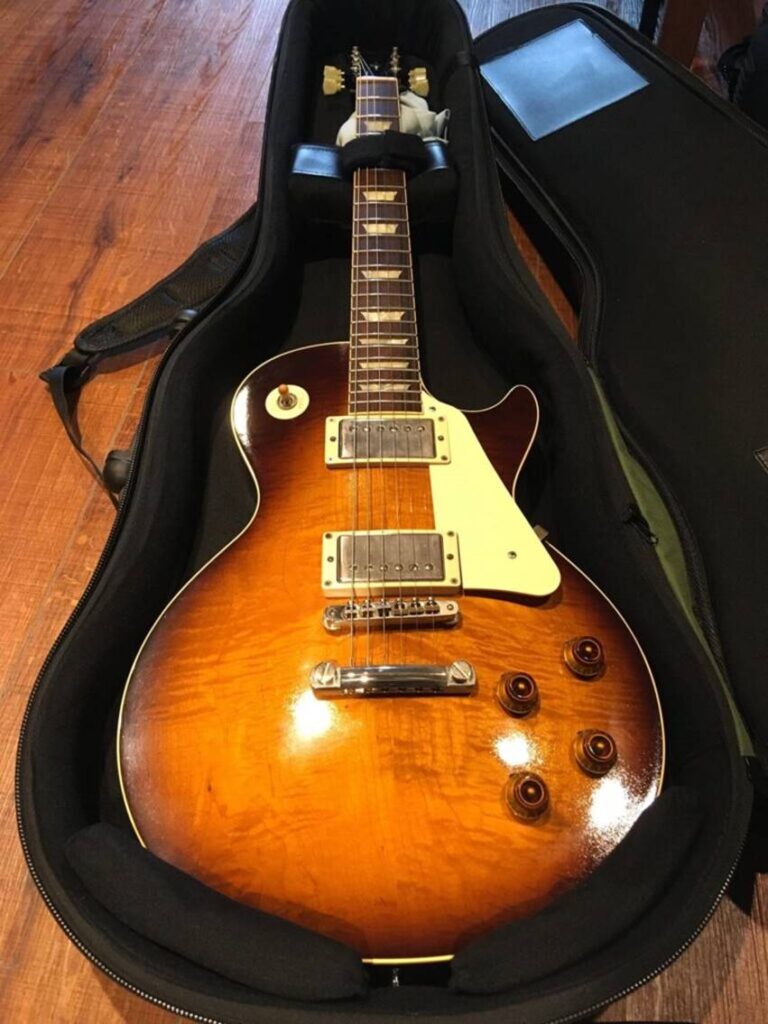
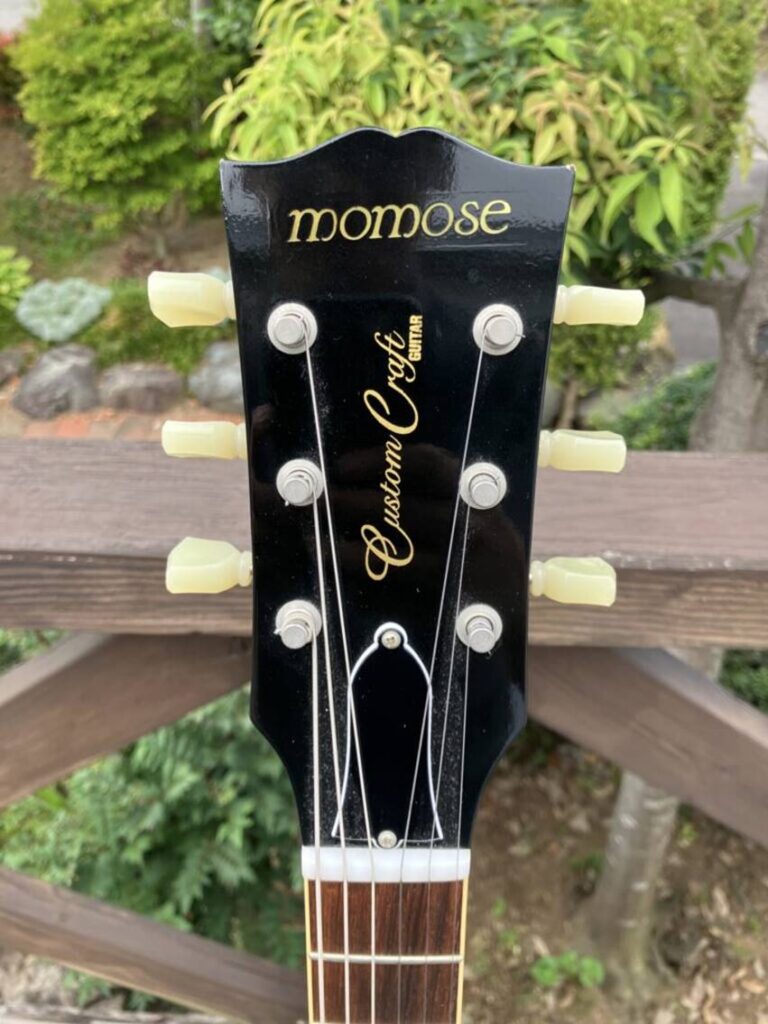
This is a review of my Momose Les Paul, which I bought as the second owner.
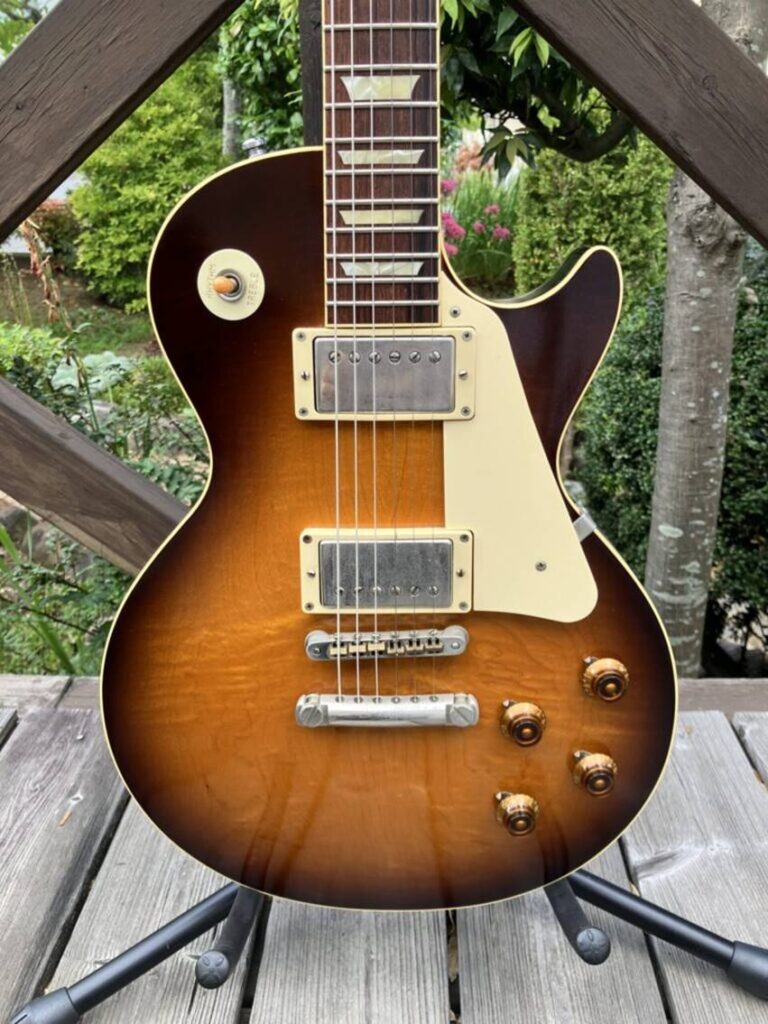
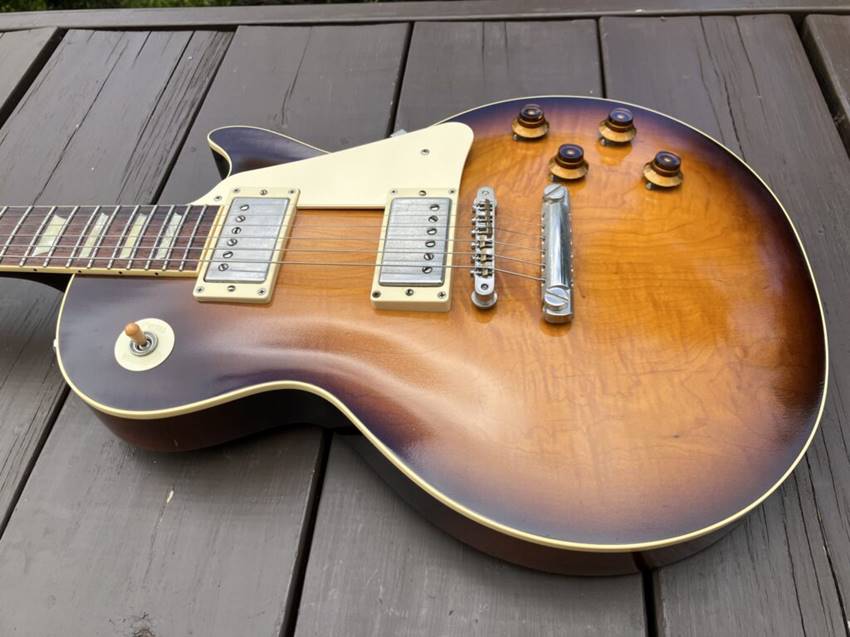
The first owner ordered this Les Paul through Oguchi Gakki. He visited the Aska factory, where he and the guitar shop staff selected a bookmatched two-piece maple top for the guitar. The guitar was then built by Momose. The neck and body are made of mahogany, which I believe is the standard grade.
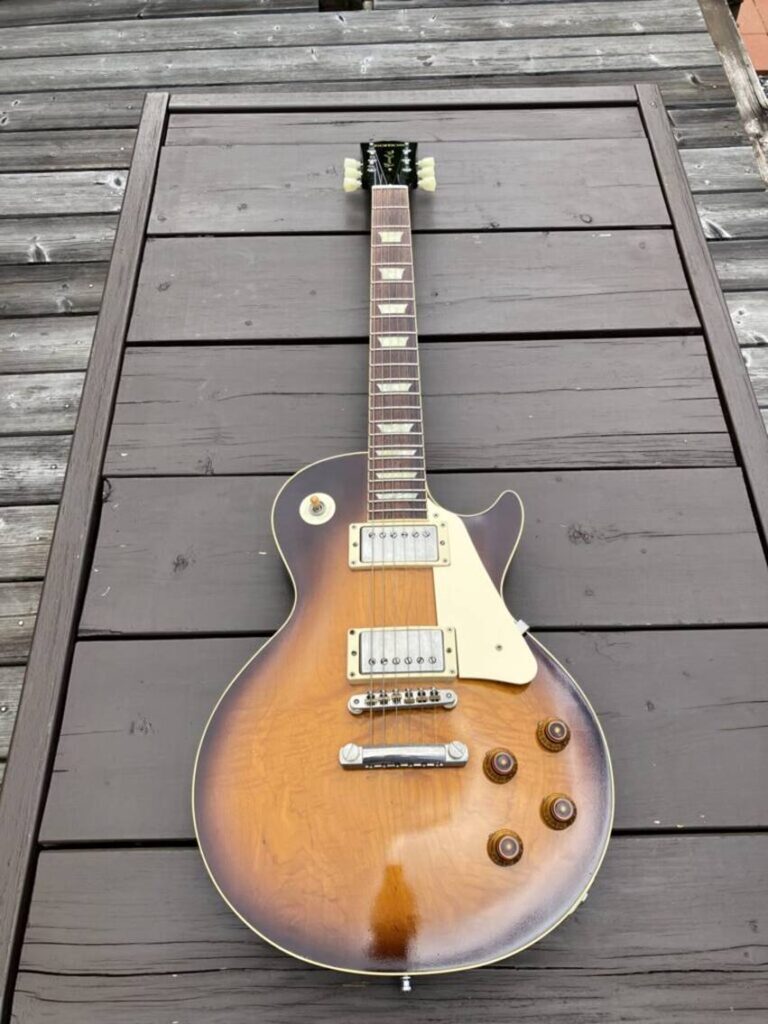
The finish has a distinctly 1970s look. I really like it, and it was one of the reasons I decided to buy the guitar.
This guitar has been modified to be almost the same as my Gibson Les Paul. I’ll explain the modifications below.
Here is the article about Gibson Custom Shop Historic Collection 1959 Les Paul.
This is a photo taken when I was a jam session. The maple top changes dramatically depending on how the light hits it.
First Impressions
When I bought the Momose Les Paul, there were a few things about my Gibson Les Paul that I wasn’t completely satisfied with. I wanted another Les Paul with clearer high frequencies and a lighter weight.
I told the guitar staff at Oguchi Gakki about it, then he said “You should try the Momose Les Paul”, and he showed this guitar.
I tried it, and immediately noticed that it was quite different from the Gibson Les Paul. The Momose had clearer high frequencies, which seemed to suit the J-pop band I was playing with at the time. The Gibson sounded a little too strong for the band and my musical style.
Specifications
Basically, I’m pretty sure that my Momose is based on the MLS1-STD. As I mentioned earlier, the body has a selected two-piece maple top, and the guitar has a Non-Buff finish.
| Items | Details |
| Body | Mahogany / Selected 2-piece Maple |
| Neck | Mahogany |
| Fingerboard | Rosewood |
| Pickup | Yuta |
| Guitar Finish | Non-Buff finish |
Modifications
The guitar is currently equipped with:
- Pickup:Gibson 57 Classic
- Pot:CTS with brass shaft
- Capacitor:Old Bumble Bee
- Bridge:Crews brass saddle bridge (Unknown model number)
- Tailpiece:GOTOH aluminum tailpiece (Unknown model number)
- Machine heads : GOTOH with brass post (Unknown model number)
Below, I’ll explain why I made these modifications. My goal was to make the guitar more similar to my Gibson Les Paul.
Pickups
The Gibson 57 Classic was originally installed in the Gibson Les Paul. Since this pickup was originally installed in a Gibson manufactured in 1999, it has been around for quite a while.
I had a very different impression of this pickup when it was installed in the Gibson. The sound is well balanced, and the first and second strings have particularly good resonance when I pick them.
As for the original “Yuta” pickups, they had a balanced and clear sound, but I found them somewhat flat. The sound was a little too dry and bland for my taste, so I replaced the Yuta pickups with the Gibson pickups. That said, I really liked the relic-style pickup covers. They looked very cool.
Volume and Tone
Also, the Volume and Tone Pots are the same CTS with brass shaft as the Gibson Les Paul. I feel that the brass components give the guitar a fatter sound, so I prefer them.
Capacitors
I really liked the combination of the Gibson and Bumble Bee capacitors, so I replaced the original capacitors with vintage Bumble Bee capacitors. I think the assembly for Japanese guitars might be a good idea to model after with Gibson or Fender. If they change their assembly, this might be one way for Japanese guitar manufacturers to achieve a richer sound.
Bridge
I replaced the original bridge with a Crews brass saddle bridge. The brass components give the guitar a mellower sound.
Tailpiece
I bought a second-hand GOTOH aluminum tailpiece when I lived in Tokyo, I cannot remember the model number. But I was attracted to the “aluminum” and bought it. Because aluminum is lightweight, I feel that it gives the guitar a more open sound.
Tuners
Same here for this, I know the tuners with a set that features brass posts get a good outcome. They give the guitar a woodier, warmer, and more organic sound with a solid core.
Sound Sample
Here is a sound sample of my Momose Les Paul, playing a melody over an acoustic rock backing track.
For more details about the equipment and recording setup, please visit the Sound Sample page.
Final Thoughts
I’ve been using this Momose Les Paul for many years. When I bought this guitar, I used this Momose and the Gibson depending on the situation. However, After I returned to my hometown, I modified the Momose Les Paul to make it more similar to my Gibson.
I plan to keep using this guitar for many years. As someone from the Matsumoto area, I also like the fact that Momose guitars are made in Matsumoto.
日本語版 : Momose Les Paul(オーダー品)|15年使ってみた長期レビュー