
The Gibson Custom Shop Historic Collection 1959 Les Paul (1999) is one of the most treasured guitars I have owned for over 20 years.
This is a Historic Collection ’59 Les Paul finished in the rare Trans Red color. When I bought it, I was a huge fan of Slash, and that was one of the biggest reasons I chose this guitar. Back then, Gibson had also released Slash signature models featuring the famous Slash’s Snakepit inlay.
Over the years, however, I have modified this guitar extensively. At this point, there may be very few original parts left besides the wood itself and a handful of hardware.
Let’s start with some photos.
Overall view. It is currently equipped with a Bigsby vibrato.
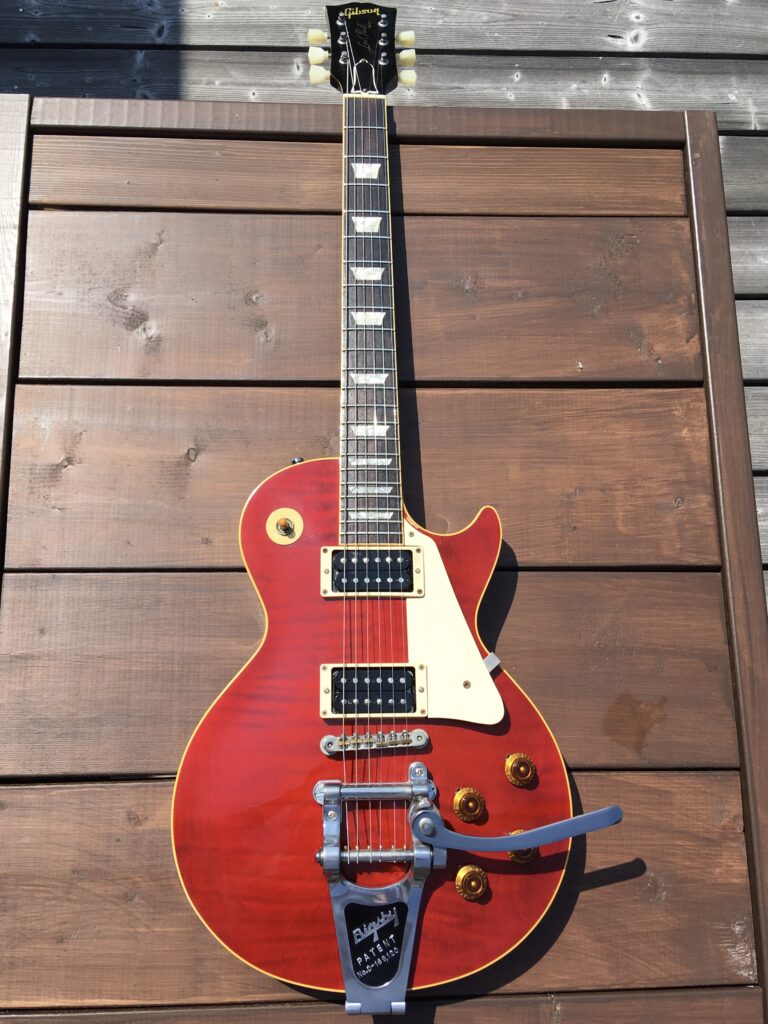
The flame maple top changes dramatically depending on how the light hits it.
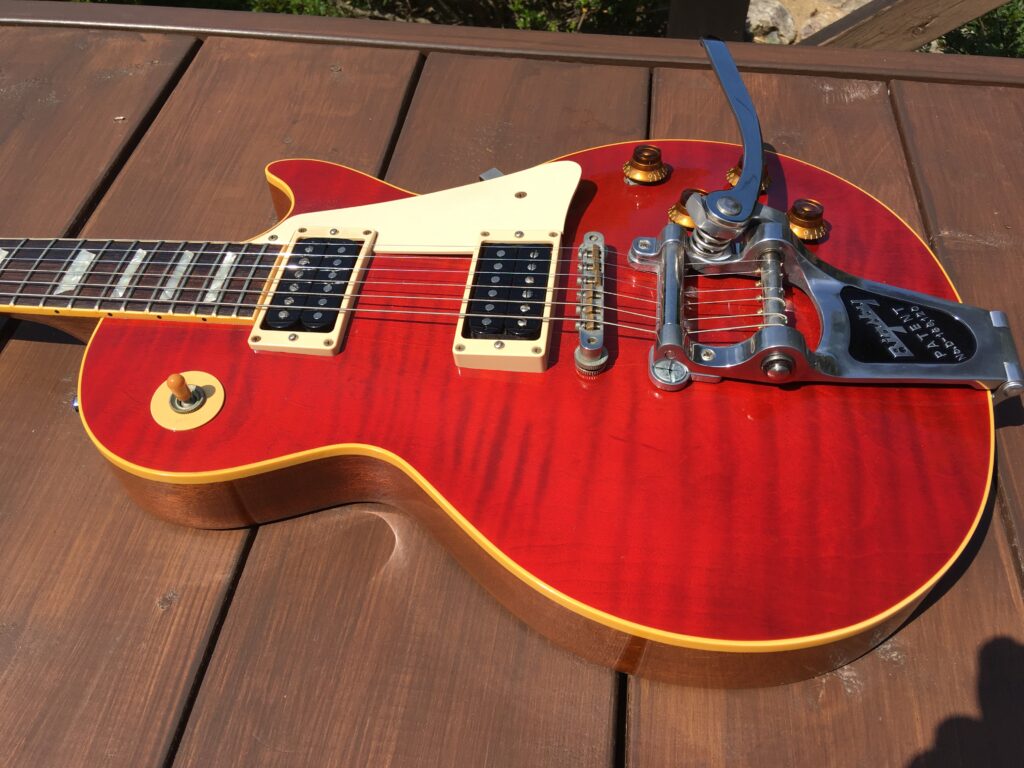
After more than two decades of playing, the finish has naturally developed scratches and lacquer checking, giving the guitar plenty of character.
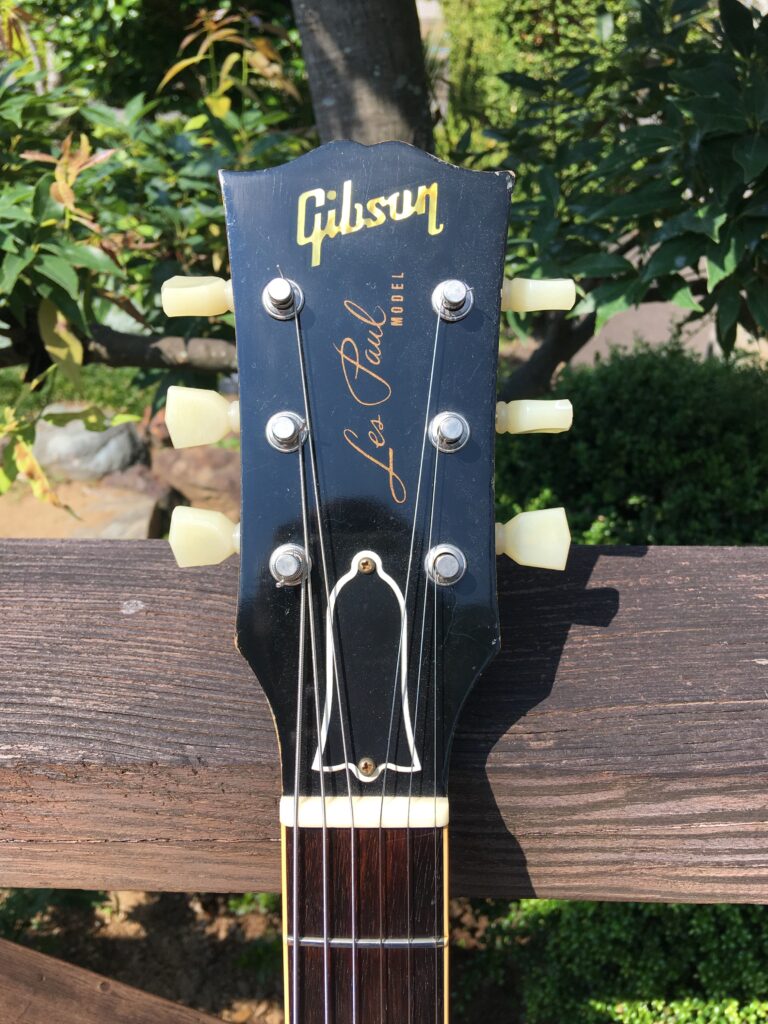
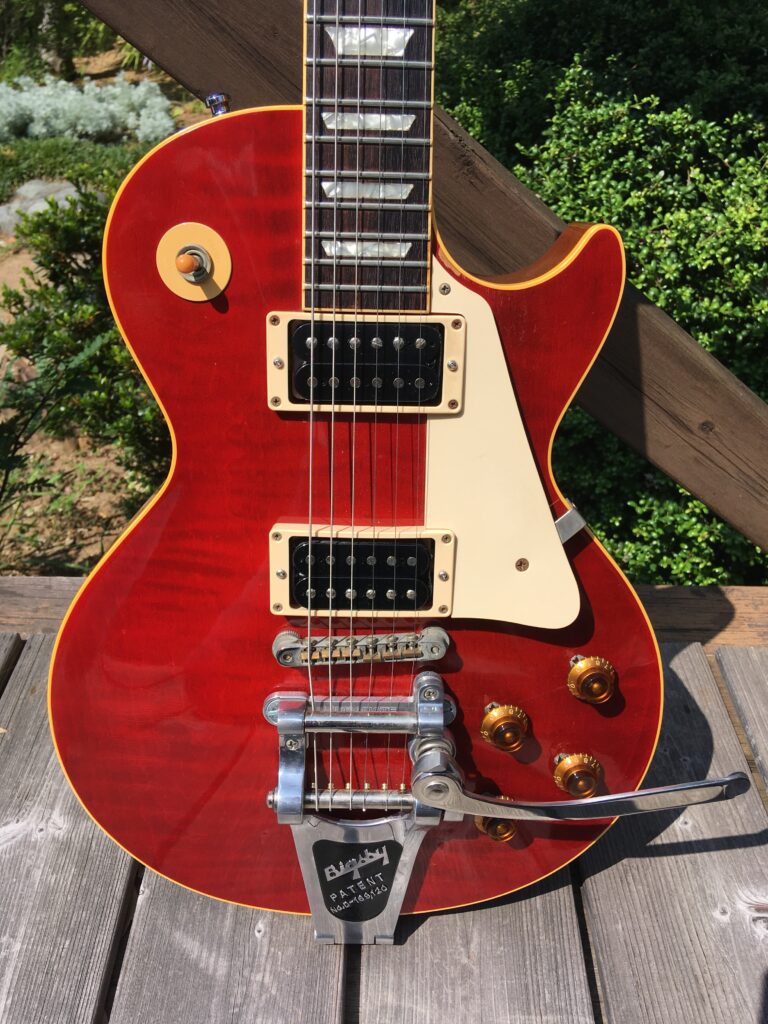
Although the guitar was built in 1999, I purchased it a little later as a brand-new instrument, so I am still its first owner.
First Impressions
At the time, I also owned a regular production Gibson Les Paul Standard. Comparing the two immediately revealed some significant differences.
- The neck was thicker but surprisingly comfortable to hold.
- It felt lighter than the regular production model.
- It was much louder acoustically.
- The thin nitro finish allowed you to actually feel the grain of the wood.
- Through an amplifier, the notes had excellent clarity and separation.
To be honest, I was amazed.
That was the moment I realized that the Historic Collection was something truly special, and I still remember that first impression today.
Specifications
The basic specifications are those of a traditional Les Paul. The only unusual feature was the limited-production Trans Red finish.
| Specification | Details |
| Year | 1999 |
| Model | Historic Collection 1959 |
| Color | Trans Red |
| Body | Mahogany / Maple |
| Neck | Mahogany |
| Fingerboard | Rosewood |
| Weight | Over 4 kg (8.8 lbs) |
Modifications
The guitar is currently equipped with:
- Pickups: Vanzandt Tru Bucker 4C
- Pots: CTS
- Capacitors: Vintage Bumble Bee
- Bridge: Crews brass saddle bridge
- Tailpiece: Bigsby + Vibramate
- Nut: Oil-soaked bone
Below are the reasons why I made these modifications and my impressions after using them.
Pickups
I’ve experimented with several different pickups over the years.
57 Classic (original) → Voo Doo HB59 → Gibson BurstBucker 1 & 2 → Vanzandt Tru Bucker 4C (current)
The original 57 Classics are now installed in my Momose Les Paul, where they turned out to be a perfect match.
The shortest-lived pickups were the BurstBuckers. They sounded good, but I never became comfortable with the balance between the #1 and #2 pickups.
I used the Voo Doo HB59 for quite a long time. At the time, my playing style favored a tighter, cleaner low end, and they suited that perfectly. Later, as my musical preferences changed, I wanted a fuller sound and eventually replaced them.
I’m now extremely satisfied with the Vanzandt Tru Bucker 4C pickups.
They remind me somewhat of a BurstBucker 1, but with a brighter top end and a subtle warmth that makes them feel more organic. I also love their excellent note separation, which keeps chords and lead lines clear without becoming muddy.
One of my favorite characteristics is that the bridge pickup never sounds thin or weak. Considering their performance, I also think they’re reasonably priced.
Volume and Tone Pots
The guitar is fitted with CTS custom pots.
I replaced the original pots many years ago because I wanted to eliminate signal leakage. It’s been quite a while, but I’m fairly certain they are CTS custom pots.
Capacitors
I also experimented with several different capacitors before finally settling on a vintage Bumble Bee capacitor.
Unfortunately, I never took photos of the electronics, but when I first installed it, I remember opening the control cavity just to admire it.
I purchased it from a vintage guitar parts dealer that has always treated me well.
Sonically, it added more depth and three-dimensionality to the sound. When using overdrive, the notes seemed to push forward with a pleasant bloom. I also love the sweet tone when rolling back the tone control, but what impresses me most is the sense of dimension that this capacitor brings.
Bigsby
The Bigsby was also installed later.
I wasn’t brave enough to drill holes into this guitar, so I mounted it using a Vibramate, allowing the installation without any permanent modifications.
I had hoped it would change the sound, but honestly, the biggest reason I installed it was simply because it looked amazing.
Years ago, I saw another Trans Red Les Paul fitted with a Bigsby online, and I instantly fell in love with the appearance.
It does affect the tone, though. The added mass gives the guitar a slightly more metallic character. On the other hand, the extra weight may not appeal to everyone.
Tuners
I honestly can’t remember the manufacturer anymore (they might be Gotoh), but I replaced the original tuners with a set that features brass posts.
The recommendation came from my local guitar shop, and I ended up loving the result.
I’m not sure if “fatter” is the best word, but the guitar gained a stronger core to its tone along with a more natural, organic response. I especially enjoy the subtle attack when the pick strikes the string.
Bridge
I replaced the original bridge many years ago with a Crews brass saddle bridge.
This is definitely one of those modifications that comes down to personal preference.
For me, it softened the sound just enough to make it more pleasing, although some players might feel that it slightly reduces brightness and projection.
Nut
The nut has been replaced with an oil-soaked bone nut.
It was custom-made by my local guitar shop, so I’m not sure of its exact origin, but I’m very happy with both its appearance and performance.
Final Thoughts
The thin nitro finish has aged beautifully over the years, developing lacquer checking and wear on the back of the neck that give the guitar tremendous character.
After more than twenty years of playing and carefully choosing upgrades, this Les Paul has truly become my own unique instrument.
It’s a guitar that has grown older alongside me, and I hope we’ll continue making music together for many years to come.
If you’re considering a Gibson Historic Collection Les Paul, I hope my long-term ownership experience helps you decide whether this legendary guitar is the right one for you.