
In 2024, I started wondering what a Precision Bass would be like to play. I talked to the staff at a local guitar shop I often visit and did some research. Then I found this bass on Yahoo! Auctions at a reasonable price, so I decided to buy it.
This is from Bacchus’s BEGINNING OF THE NEW TRADITION series, so it is more than 20 years old. There was another bass I was considering, but the staff at the guitar shop recommended this one because they thought it looked more interesting. That was the deciding factor.
I don’t know the exact model number, but apparently Bacchus produced some instruments that were outside their regular catalog specifications at the time.
As with many of my instruments, I have made several modifications to it since I bought it. So today, I’d like to introduce this Precision Bass.
AMPEG RB-115 and the Precision Bass
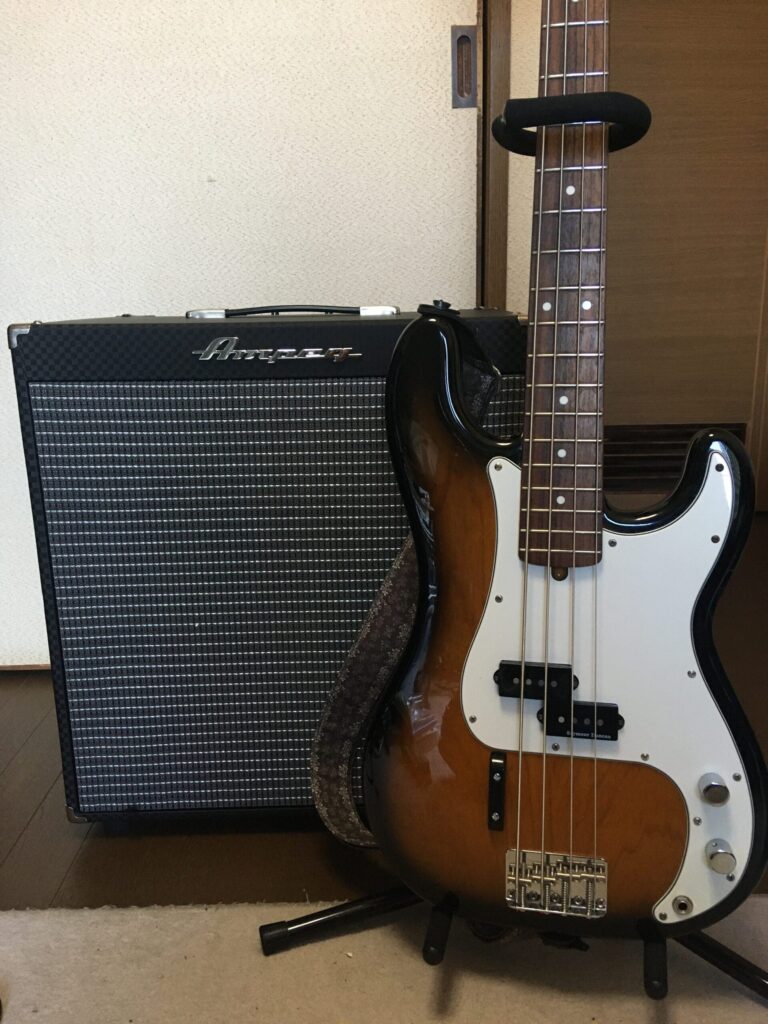
First Impression
When I bought this bass, I already owned a Jazz Bass from Rever Head, the brand that preceded Bacchus. Compared with that bass, my first impressions were:
- The neck feels fairly wide, with a modern-style Precision Bass nut width of 42 mm. It doesn’t feel extremely thick.
- It weighs about 4 kg, which feels just right to me. I don’t get tired even when playing it with a strap.
- The original pickup had fairly high output.
Overall, I think it was designed with specifications that were not too vintage-oriented, while still being suitable for the music of that era.
Since I had only played Jazz Bass before, I expected that I might have some trouble getting used to the wider and thicker neck. However, I got used to it surprisingly quickly.
Specifications
I don’t know the exact model number, but here are the specifications as far as I can tell from the materials and other details.
| Item | Specification |
|---|---|
| Year | Around 2000 |
| Model | Precision Bass |
| Color | 3-Color Sunburst |
| Body | 2-piece Ash |
| Neck | Maple |
| Fingerboard | Rosewood |
| Weight | 4 kg |
The combination of an ash body and a rosewood fingerboard may be somewhat unusual. I think ash with a maple fingerboard, or alder with a rosewood fingerboard, are more common combinations.
After getting this bass, I realized that I actually own quite a few instruments with ash bodies. And all of them are relatively lightweight, which makes them easy to handle.
Some people say that ash-bodied instruments lack low-end, but I haven’t had any problems using them. A lightweight instrument is also much easier on my back.
Modifications
The current specifications are:
- Pickup: FENDER Pure Vintage ’63 Precision Bass Pickup
- Bridge: SCUD T-117N/S (I think)
- Other: Finger rest
Pickup
I have actually replaced the pickup twice.
The original pickup had too much output, so I replaced it fairly soon after buying the bass.
The first replacement was a SEYMOUR DUNCAN SPB-1 Vintage P-Bass. It had a sweet tone and relatively moderate output, and I liked it.
However, the more I played it, the more I wanted a little more low-end punch, a stronger sense of weight in the sound, and a drier tone.
I eventually replaced it with the FENDER Pure Vintage ’63 Precision Bass Pickup, which is what I use now.
I decided on it after watching various videos and listening to different examples.
I’m completely satisfied with it. The things I felt were missing with the Duncan pickup are no longer an issue. I don’t have to put as much effort into playing, and I can get a great tone very easily. It feels very comfortable to play.
Bridge
Another modification was the bridge.
The original bridge was a Badass-style bridge, so I replaced it with a spiral-type bridge. I changed it to a SCUD bridge, although I’m not completely sure about the exact model number.
The Badass-style bridge was good too, but I felt that the sound had a slightly compressed character that I didn’t really like. I also wanted to see what a more conventional spiral-type bridge would be like, so I decided to give it a try.
Finger Rest
I also installed a finger rest.
I originally installed it because I liked the tone I got when playing closer to the bridge.
Recently, however, I’ve found that I also like the sound I get when resting my finger on the pickup, so now I simply play at whichever position feels best at the time.
Conclusion
After playing the Precision Bass for a while and then picking up my Jazz Bass, I started to understand the characteristics of the Jazz Bass much better.
I feel that the Jazz Bass works well when you need to place notes in the gaps between many overlapping parts.
The Precision Bass, on the other hand, seems to work especially well in a simple arrangement, such as a trio, where the bass can help fill out the space.
Of course, I’m primarily a guitarist, so an experienced bass player might disagree with me on that.
Personally, I actually find the Precision Bass more comfortable and enjoyable to play.
I especially love the sound when I play it through the Ampeg RB-115 shown in the photos. I would like to write about the Ampeg on this blog at some point.
This is my third bass amp, and I’ve finally settled on this one. I also use it for home recording, sometimes placing a microphone in front of it and experimenting with different setups.
I haven’t made my debut as a bass player yet, but if I get the opportunity, I’d like to take it out and play it somewhere.
日本語版 : Bacchus BEGINNING OF THE NEW TRADITION Series